Occasional dispatches from The Farm at Mirrim Wurnit — what
we’re doing on the land, what we’re learning through our
musings or the people we spend time with, and what’s happening
with the animals and the creek. Written slowly and often in long form,
published when there’s something worth saying.
1 October 2026Regenerative practice
Planting a community at Mirrim Wurnit
When we plant on The Farm at Mirrim Wurnit, we start with the neighbours. Before
choosing a tree, we ask which plants will grow around it.
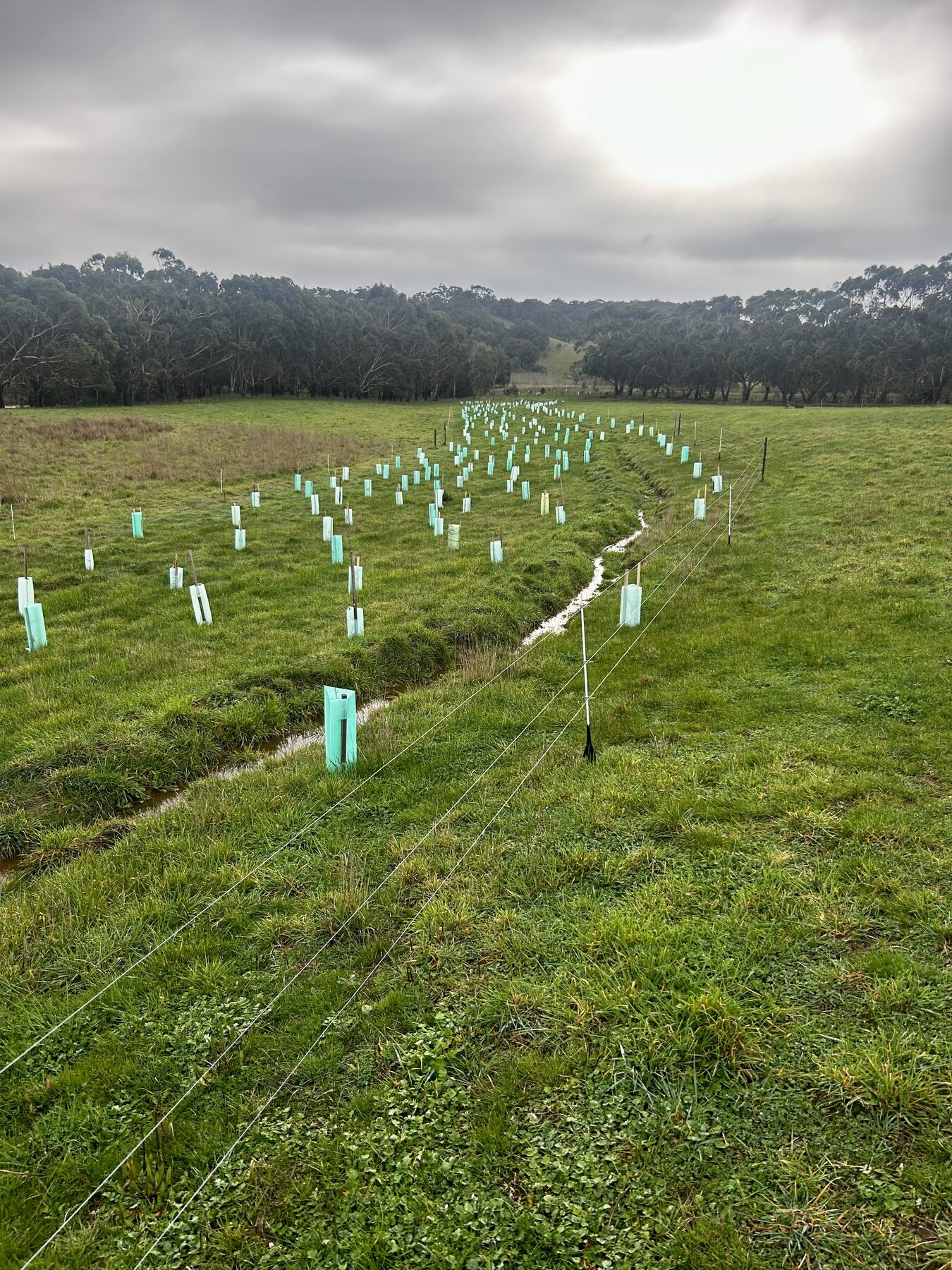
June plantings below the contour swale, settling in by late winter.
On the basalt plains near Deep Creek, a lone snow gum faces wind and
frost with nothing beside it. Put Poa labillardierei at its
base, Acacia paradoxa and Dodonaea viscosa close
by, and Carex along the wetter ground, and the same tree has
shelter, ground cover and moisture held in the soil. Tussocks cover
the soil surface. Wattles fix nitrogen. Shrubs give small birds
somewhere to hide. Leaf litter feeds the worms and fungi, then
insects arrive, and birds follow the insects.
Our June planting day put more than 800 plants into two sites, the
contour swale and the exposed ridge, with 25 people helping. At each
site we chose the eucalypts and acacias that suit its conditions,
and planted them alongside groundcovers and shrubs from the local
grassy woodland community.
Along the roadside, we burnt off four separate plots and planted into
each one. Every plot received the same working mix:
Cassinia longifolia, Dodonaea viscosa,
Poa labillardierei, Acacia provincialis and
Allocasuarina verticillata. That gives a shrub layer, a
tussock layer, a wattle and a she-oak in each patch. Four plots will
also show us how the same mix develops in slightly different spots.
We always add plant matter to our plantings: logs, branches, leaves
and mulch. We put down extra along the roadside. It breaks down over
time and feeds the soil. Just as important, it gives insects and
small animals like lizards somewhere to live while the plants grow.
Every planting decision on the farm gets one question: does this add
to life? We count soil biology, grasses, trees, livestock, insects
and birds. We choose the plantings that add to several of these at
once.
22 August 2026Energy & resilience
Energy, Resilience and the Long View
There is no tractor on The Farm at Mirrim Wurnit.
People are often surprised by that. A hundred-acre farm on Deep Creek in the Macedon Ranges seems the sort of place that ought to have a tractor parked in a shed somewhere, with a slasher and bucket excavator. We don't. That wasn't the result of a grand plan. It simply reflects the direction our thinking has taken over the years.
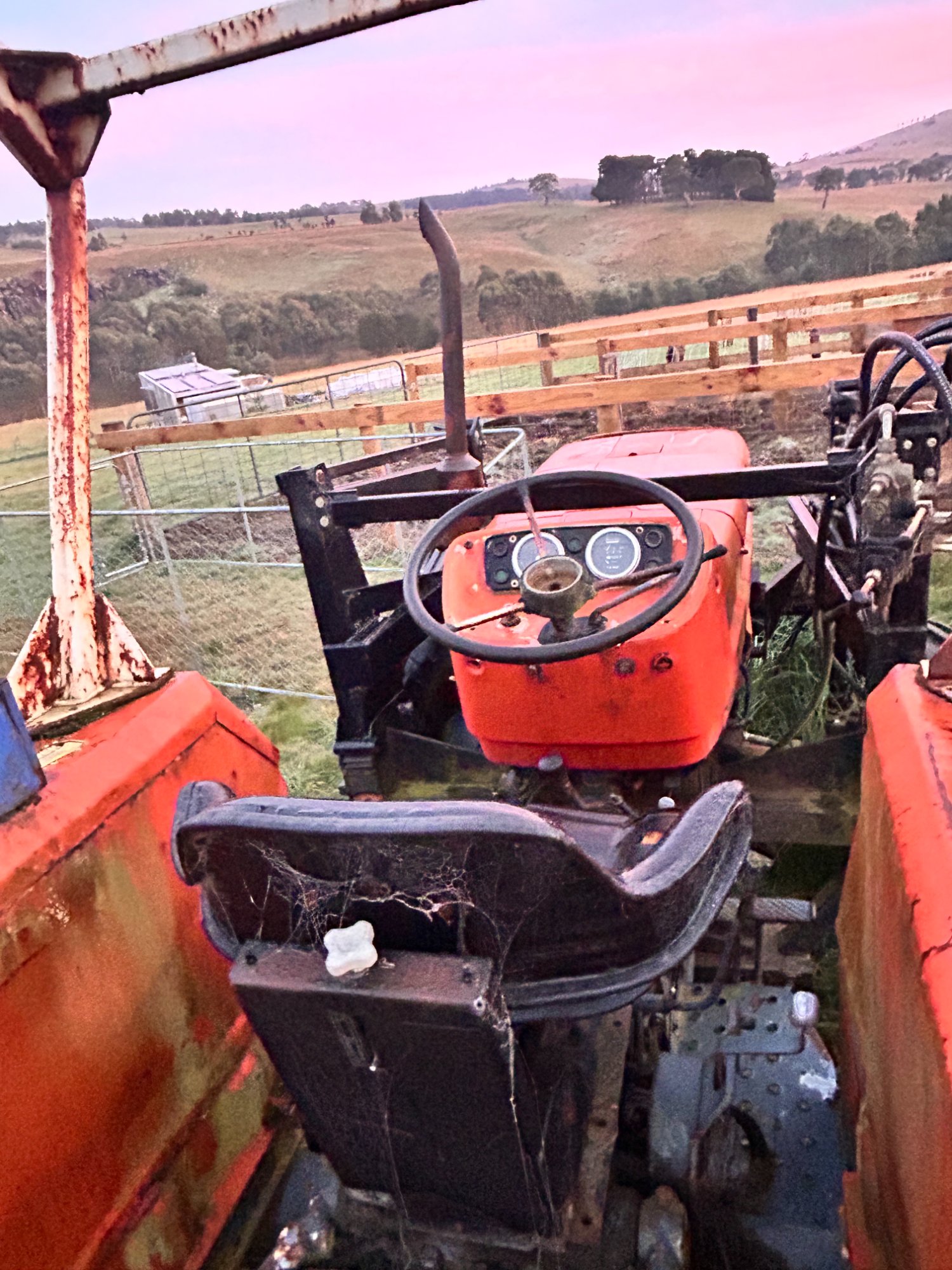
The old Fiat tractor we bought, but then sold, mainly due to my complete lack of maintenance skills!
Living on an off-grid property changes the way you think about energy. Out here, energy becomes a major factor in everyday decisions in a way that it rarely does in towns and cities. The grass feeding the cattle is stored sunlight. Rain falling on the catchment becomes water in the tank. Firewood cut and stacked in spring becomes heat the following winter. Spend enough time paying attention to these relationships and energy starts to seem less like a commodity and more like a flow moving through a landscape, captured, stored and transformed in different ways — the same logic behind the contours we cut along natural steps in the paddocks, holding rain long enough to spread out and soak in rather than run straight off toward the creek.
Long before moving here I spent part of my career in the upstream oil and gas industry. More recently I have worked in renewable energy and what is commonly referred to as the energy transition. Moving between those worlds has left me increasingly occupied by a question that seems both simple and profound: can the entire system produce enough net energy, reliably enough, to support modern civilisation?
The older I get, the less certain I am of the answer.
That uncertainty does not arise from opposition to renewable energy. Quite the opposite. Wind, solar and batteries are remarkable technologies and will almost certainly play an important role in whatever comes next. What has changed is my appreciation of the scale of the system they are being asked to support.
Modern civilisation is not built on electricity alone. It is built on a vast web of fuels, materials, infrastructure and supply chains developed over more than a century of abundant fossil energy. Much of that complexity has delivered extraordinary benefits. It has also allowed many of us to become disconnected from the physical realities that underpin our lives.
A tractor provides a useful illustration.
A tractor is a remarkable machine, allowing one person to perform work that would once have required many hands and many days. Yet a tractor is never just a tractor. It is diesel. It is steel, copper, rubber and electronics. It is mines, factories, shipping lanes, workshops and spare parts inventories. Like so much of modern life, it is the visible expression of a much larger system.
The question for us was never whether tractors are useful. Of course they are.
Many farmers around here possess skills I deeply admire. They can maintain machinery, rebuild engines, weld, fabricate and keep equipment operating long beyond its expected life. That is a genuine form of resilience.
I am not one of those people.
My own skills lie elsewhere. I can move sheep and cattle through a grazing plan, observe what they are eating and what they leave behind, think about water movement across a landscape, develop a whole-of-farm plan and spend time restoring biodiversity. Those are the capabilities I have chosen to invest in. It is why the diesel we still burn here runs a backup generator rather than a fleet of machinery — a compromise we would rather shrink than expand.
Over time I realised I was better served developing those skills than accumulating machinery I neither understood nor particularly wanted to maintain. That led to a different question: how much machinery did we really need, and how might we design the farm differently if our goal was to reduce dependence on external inputs rather than increase it?
The answer has gradually nudged us in a particular direction. Towards more trees and fewer machines. Towards working with natural processes wherever possible. Towards reducing our dependence on external inputs. Whether that proves wise in the very long term remains to be seen, but it feels increasingly aligned with the kind of resilience we hope to build here — the same instinct that has us handing whole corners of the property back to habitat and creek corridor rather than running it wall to wall as production ground.
This way of thinking owes something to the anthropologist Joseph Tainter, whose work on the collapse of complex societies has increasingly influenced me in recent years.
Tainter argued that societies solve problems by becoming more complex. New technologies, institutions and infrastructure often produce enormous benefits. Yet complexity is not free. Every solution creates new systems that must be maintained. Every layer requires resources, energy and attention. Over time, societies can find themselves devoting an increasing share of their efforts simply to sustaining the complexity they have already built.
I find myself returning to that idea often.
Most of the time the systems underpinning modern life work so well that they become invisible. Then something happens. A drought. A pandemic. A war. A disruption to shipping. A shortage of fuel. Suddenly we are reminded how dependent our daily lives are on systems we barely notice when they are functioning normally.
Running an off-grid farm has not made me pessimistic about the future. If anything, it has deepened my appreciation for resilience.
The solar system keeps working quietly every day. The tanks fill when it rains. Trees we planted as small seedlings along the fence lines are slowly becoming windbreaks and providing shade in the paddocks, not to mention resting spots for birds and homes for insects. Nature has a remarkable capacity for self-organisation when given the opportunity: dung beetles have started turning up from neighbouring properties, unbidden, quietly tunnelling cattle dung into the soil. Nobody ordered that. It is simply what happens when the conditions are right.
Perhaps that is one reason regenerative agriculture resonates so strongly with us.
At its heart it is not really about a collection of farming techniques. It is about relationships. Between soil and plants. Water and landscape. Animals and ecosystems. People and place. Healthy landscapes emerge from many small interactions reinforcing one another over time. They become resilient not because they are simplified, but because they are well connected — visible in something as small as clover creeping back into ground that used to be bare between the tussocks, quietly doing the work of feeding the soil that no machine ever could.
I suspect communities and societies may not be entirely different.
I still believe we need to reduce our dependence on fossil fuels. What I no longer take for granted is the assumption that the future will simply be a cleaner version of the present.
The energy transition is often described as a story of substitution: fossil fuels out, renewables in. Reality may prove more complicated.
The trucks moving wind turbine components, the mining fleets extracting copper and lithium, and the ships carrying solar panels and batteries around the world still depend overwhelmingly on fossil fuels. The old energy system is building whatever comes next.
Whether that next system will provide the same abundance of energy that industrial society has enjoyed over the past century remains an open question. It may. I hope it does.
But it is equally possible that future societies learn to operate with lower energy and material inputs than we have become accustomed to. Not because anyone chooses austerity, but because the age of abundant, concentrated fossil energy proves difficult to replicate.
I do not know which of these futures will emerge.
What I do know is that the uncertainty has shaped how we think about this place, The Farm at Mirrim Wurnit, the name given to us by the Traditional Owners for Deep Creek in the Woi wurrung language.
Why we live off-grid.
Why we try to work with natural systems rather than against them.
Why there is no tractor in the shed.
And why, when faced with a choice between greater complexity and greater resilience, we increasingly find ourselves choosing resilience.
Not because we know what the future holds, but because resilience seems valuable under almost any future.
Whether the decades ahead bring technological abundance or tighter energy constraints, healthy soil, secure water, diverse ecosystems and strong local communities are unlikely to be mistakes.
Notes
This piece has been influenced by several writers whose work I have found myself returning to in recent years.
Joseph Tainter, The Collapse of Complex Societies (1988). A profound exploration of complexity, diminishing returns and the long-term sustainability of human societies.
Vaclav Smil, particularly Energy and Civilization and How the World Really Works. Smil's work provides a grounding in the physical realities of energy systems and the timescales over which large-scale transitions occur.
Ed Conway, Material World (2023). A fascinating examination of the material foundations of modern civilisation and the enormous flows of energy and resources that underpin everyday life.
Wendell Berry, particularly The Unsettling of America and his collected essays. Berry's writing explores stewardship, community, restraint and the enduring relationship between people and the land that sustains them.
None of these writers would necessarily agree with all of the conclusions drawn here. But together they have shaped how I think about energy, resilience, complexity and the long-term stewardship of land.
Peter The Farm at Mirrim Wurnit · Monegeetta, Victoria
20 August 2026Regenerative practice
The Value of Untidiness
There’s a temptation, on any working farm, to keep things tidy.
Mow the standing grass, clear the fallen branches, present a paddock
that looks managed and cared for. On The Farm at Mirrim Wurnit we’ve come
around to the opposite view — that a bit of deliberate
untidiness is doing real ecological work.
Standing dead grass
In paddocks we’re resting as part of the rotation, we now let
patches of grass go to seed and stand rather than grazing or mowing
them flat. It looks like neglect. It isn’t.
Standing stalks are overwintering habitat — hollow and pithy
stems shelter native bees, beetles, and moths through the cold
months. They’re nesting material and cover for small birds and
reptiles. The seed heads feed finches and other seed-eaters when the
rest of the paddock is bare. And even the practical, unglamorous
stuff matters: a litter layer of dead grass protects soil from
crusting, holds moisture, and slowly feeds the soil biology as it
breaks down.
Logs, not piles
We’ve also started scattering logs through paddocks rather
than leaving them where they fall or clearing them off entirely.
Deliberately — logs, not brush piles. Piles of loose branches
can harbour rabbits, and keeping rabbit numbers low matters to us,
so we’ve settled on solid, well-placed logs instead: enough
structure for habitat value, without the warren-friendly cavities a
loose pile creates.
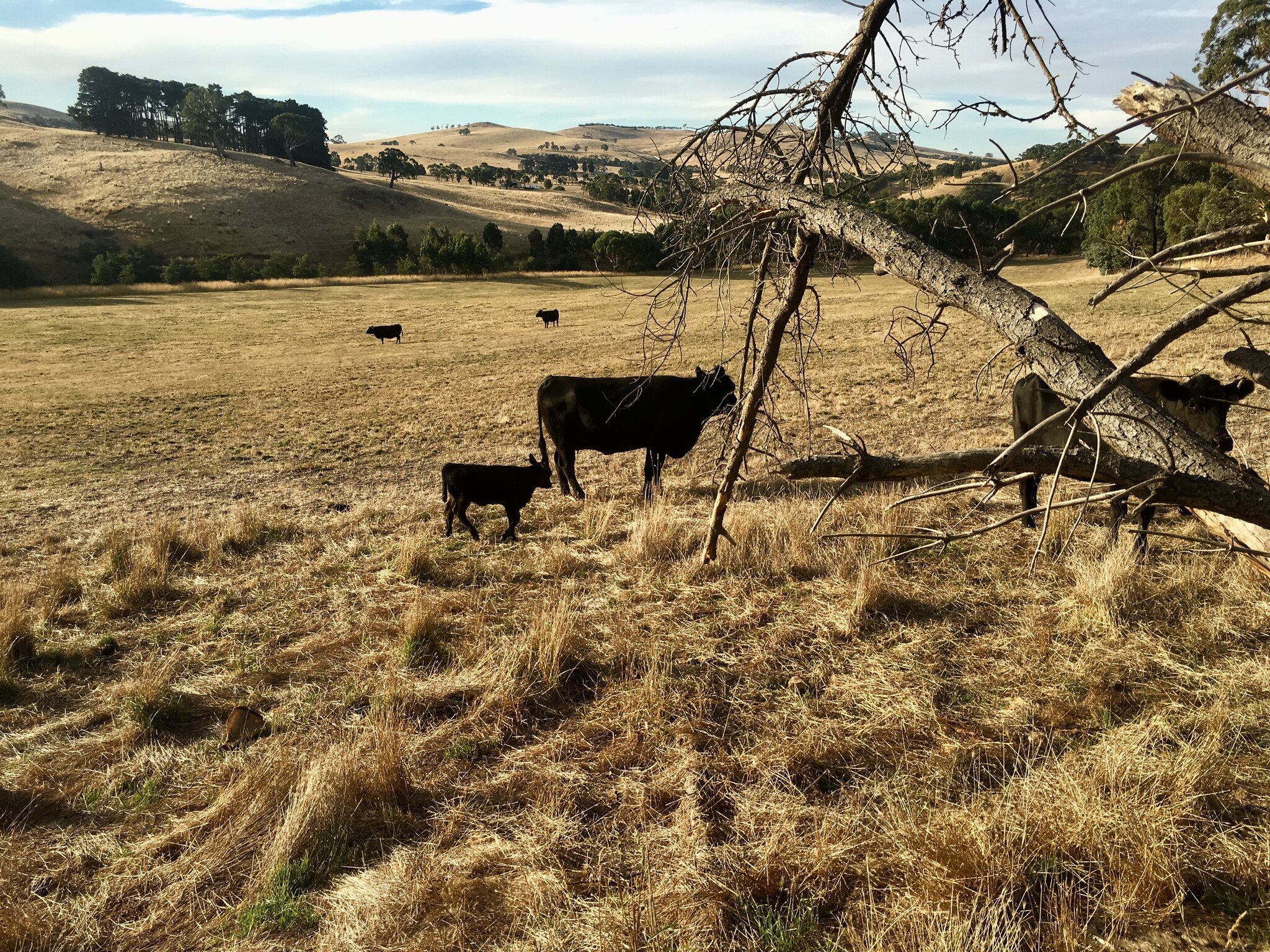
Cattle making use of a fallen tree in the paddock — rough habitat and practical shelter occupying the same ground.
Logs turn out to do several jobs at once:
Habitat complexity — they shelter skinks, frogs, and small mammals, and give insectivorous birds somewhere to hunt from
Nutrient cycling — fungal and invertebrate decomposition slowly returns what’s locked in the wood back into the soil
Microclimates — the shade and moisture under a log support different plant germination than the open pasture around it
Stock relief — cattle and sheep use solid logs as rubbing points for fly and itch relief, which takes some of the wear off fences and gates, and reduces how much they lean on chemical fly and lice control
We place the more solid ones near water points and other spots the
sheep already congregate, so they get used for scratching. The
smaller ones we spread further out, at wider spacing, closer to the
contour swales, the shelterbelt plantings, and the wildlife corridor
along Deep Creek.
Stepping stones
That spacing is deliberate. Ecologists call small, scattered
patches of habitat like this “stepping-stone habitat”
— individual spots too small to support a population on their
own, but close enough together that species can move between them. A
spider or beetle that can’t cross open, structureless pasture
can shelter at one log, then move to the next, and the one after
that.
Placed well, a scatter of logs can functionally connect habitat that
would otherwise sit isolated — linking a dam edge to a tree
line, or a patch of remnant bush to a new native planting. For us,
that means the logs aren’t just individual features.
They’re quietly stitching together the swales, the shelterbelt,
and the creek corridor into something more connected than any one
planting could be on its own.
Spiders, specifically
It’s worth saying a word for spiders, since they tend not to
get much good press. Dead grass stalks give them anchor points for
webs and safe places to attach egg sacs. Logs give ground-dwelling
spiders — wolf spiders, huntsmen — daytime retreats and
a moist microclimate to hunt from. And the habitat that supports
spiders supports the insects they feed on, which means a paddock
with some structure in it does more of its own pest control than one
stripped bare.
The general principle
None of this requires much. No capital works, no approvals, nothing
that competes with the rest of what the farm needs to do. It’s
mostly a matter of leaving a bit of what’s already there
— a patch of grass gone to seed, a log left where it lies, or
moved somewhere more useful — rather than tidying it away.
The pattern that seems to matter most is patchiness: not uniform
tidiness across every paddock, but ten or twenty percent given over
to rough refuge — corners of standing grass, a scatter of
logs, a few less-managed edges. Most of the biodiversity loss on
working land comes from over-uniform management, not from any one
practice. A little deliberate roughness, placed with some thought,
goes a long way.
12 August 2026Reflections
Roll up your sleeves
Sometimes you just need to roll up your sleeves and get things done.
Whether it’s bringing a project to financial close, solving a
commercial problem or carrying a newborn calf to safety, the
principle is the same: show up, take responsibility and do what is
needed.
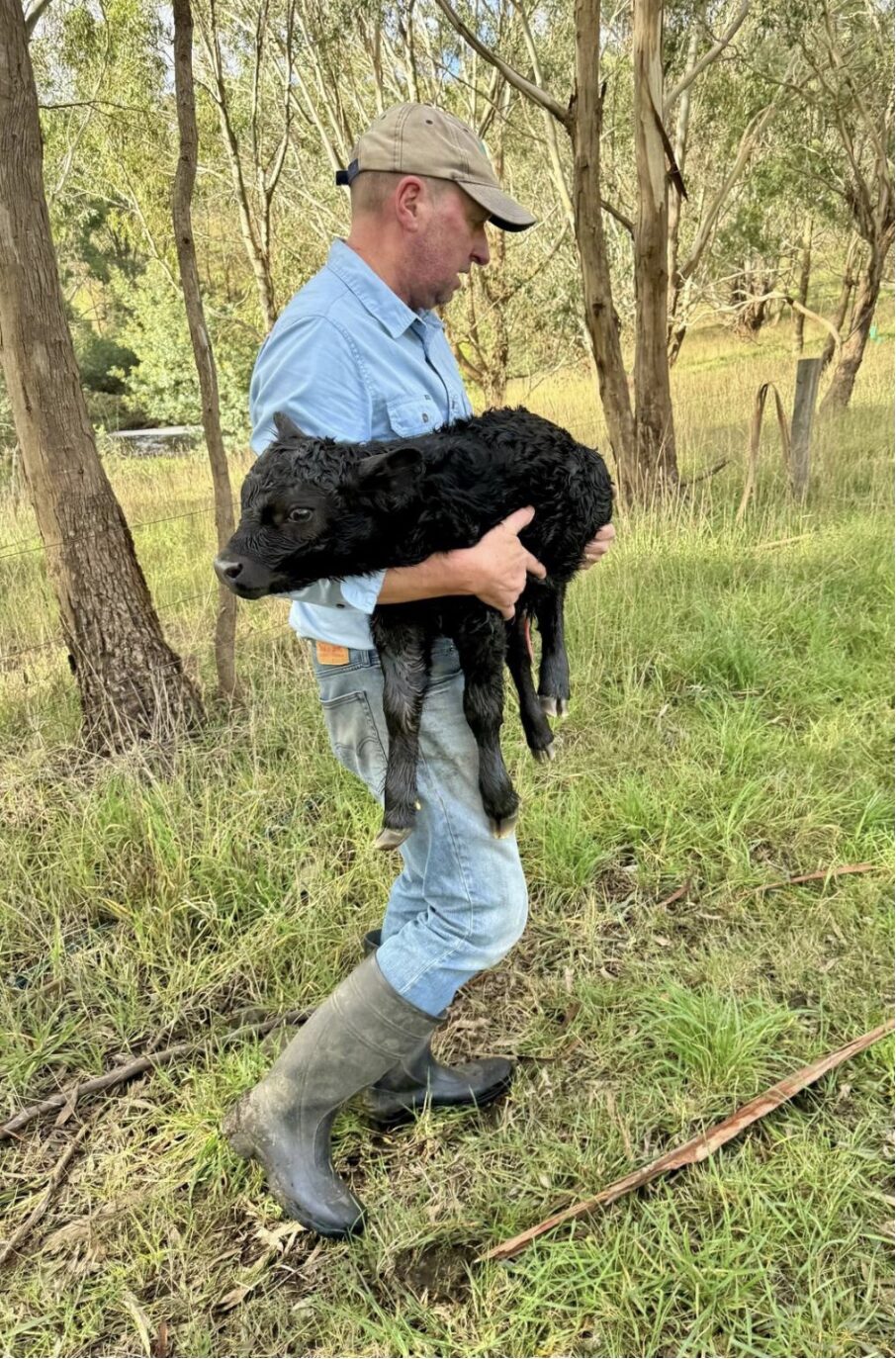
Carrying a newborn calf to safety.
Different challenges but the same mindset.
Reposted from LinkedIn.
14 May 2026Regenerative practice
Regeneration in the Home Paddock
We manage Mirrim Wurnit, a hundred acres of basalt country in the
Macedon Ranges, as a regenerative grazing property and a long-term
ecological restoration project. This post is about one specific
piece of it — the home paddock — and what six years of
changed management has begun to do to the land.
When we arrived, the paddock had been hayed most years for as long as anyone could remember, and set-stocked from time to time between cuts. It was not uniform in its condition. The creek flat at the lower end produced the best hay — deeper alluvial soils, more moisture, naturally higher fertility. The slope above was poorer. The area around the single water trough at the entrance end was the worst: heavily poached, bare, nutrient-loaded from concentrated dung and urine, and compacted by stock pressure. A small group of old pine trees in the middle, removed before we built the house between January 2019 and June 2020, left a zone of acidified, low-biology soil whose legacy is still visible. The previous owner’s cattle had also camped under the pines, adding long-term hoof compaction and nutrient loading to the acidification — about as difficult a starting point as a patch of ground can have: compacted, nutrient-overloaded, biologically depleted, and dominated by the weeds that move into exactly that kind of disturbed soil. A further row of pines remains along the road fence line, continuing the acidifying influence. Much of the slope above the old pine zone is still weedy and slow to grow grass. Weeds are not the problem — they are the symptom, pioneer species doing what nature does in disturbed, low-fertility soil. The challenge is that many of those pioneers are introduced species very good at staying once they arrive.
The home paddock is not a single uniform recovery project but a mosaic of different starting points, each responding at its own pace. The house and garden sit in the middle of the paddock rather than fenced apart from it — when stock are grazing close we use portable electric fencing to keep them away from the plantings. The clearest proof of what is possible sits right there in that garden. We began developing it in earnest in 2023 — mulching extensively, planting natives throughout, and establishing a small pond where water pooled naturally. The soil in those areas is already noticeably more friable and full of earthworms than the paddock on the other side of the temporary fence. Whether the microclimate around the house has yet changed is harder to say — that is the aim — but the direction is clear and the biology is responding.
The creek corridor tells a more advanced version of the same story. We have done extensive planting alongside Deep Creek — trees, shrubs, and grasses including Poa and Lomandra — adding to the existing Eucalyptus and Acacia overstory that runs along the creek line. The results there are already encouraging. Now that the creek flats are getting adequate rest and are no longer being hayed, we are seeing spontaneous regeneration of native trees establishing without being planted. That is the landscape doing restoration work we did not ask for and cannot fully take credit for. It is what happens when the conditions are right and the seed bank still has something to offer. It is also the most honest measure of progress we have: not what we have put in, but what the country is beginning to do on its own.
Three decisions have driven the change in the paddock since 2021. We stopped cutting it for hay — with one exception: a portion of the creek flat was cut again in 2024 simply because we did not have enough livestock at the time to eat and trample the standing grass. That pragmatic decision aside, the paddock has not been hayed since 2021. We introduced rotational grazing in place of continuous set-stocking. And in early winter 2025 we installed contour swales as part of a whole-of-landscape water management plan: one cut through the slope above the creek flat, where it intercepts rainfall running down from higher ground; and another along the creek flat itself, slowing surface water before it reaches the creek. A further contour is planned higher up toward the road at the top of the property, along with others identified in our NSF plan — including a large pond on the creek flat. Each one costs money and brings consequential decisions about fencing and water infrastructure, so the programme unfolds as resources allow. This post attempts to explain what the decisions made so far have done, why they mattered, and what we are seeing now as a result.
The home paddock, December 2020.
The Hay Problem
Hay cutting looks like farming. The paddock grows tall, the cutter comes through, the bales are stacked and carted away. It is a satisfying and visible kind of productivity. But looked at from the soil’s perspective, it is something closer to a slow withdrawal from a bank account that is not being replenished.
Every bale of hay that leaves a property takes with it the nutrients that the plants drew from the soil to build that biomass: nitrogen, phosphorus, potassium, calcium, trace elements, all of it accumulated over the growing season and loaded into the bale. Unlike grazing, where the animal returns a significant proportion of what it consumes back to the paddock as dung and urine within hours, hay cutting is a one-way transaction. The fertility goes out the gate and does not come back. The only way to sustain production under that model is to replace those nutrients artificially, year after year, which means the paddock becomes progressively more dependent on inputs even as its underlying biological capacity declines.
As Nicole Masters describes in For the Love of Soil, it is a system that treats soil as a growing medium to be fed rather than a living community to be supported. The soil does not collapse. It just quietly becomes less than it was.
The Tall Grass Paradox
A paddock full of tall grass looks, from a distance, like a well-covered paddock. And at canopy level it is. But the grasses that dominate a hayed paddock in this district — phalaris above all, along with tall fescue and cocksfoot growing in dense clumps — cast a deep shade at ground level. Phalaris in particular is allelopathic, actively suppressing the germination of other species through compounds released by its roots. It was widely sown across the Macedon Ranges for exactly the reasons that make it ecologically problematic: it establishes quickly, grows vigorously, and crowds everything else out. The soil surface between the clumps can be almost bare — no leaf litter, no prostrate stems, no low-growing species filling the gaps. When the hay cutter comes through and removes that tall growth, this is suddenly revealed: the paddock that looked covered is, at the surface where it matters most, quite open. Raindrops hit bare soil directly, breaking up the fine aggregates that give healthy soil its crumb structure and sealing the surface into a cap that sheds water rather than absorbing it.
Set-stocking between cuts compounded the problem. A single water trough at the entrance to this long paddock meant stock congregated at that end, heavily poaching the soil while the far end often accumulated rank ungrazed material. The paddock was under two forms of pressure alternately — the annual cut removing fertility and disrupting soil structure, and uneven grazing without recovery time eliminating whatever diversity remained. Neither gave the ground layer a chance.
What the Machinery Does
Heavy cutting and baling machinery passing repeatedly over the same ground — often when the soil carries some moisture — compresses the soil profile, reducing the pore space that allows water to infiltrate and air to circulate. Soil biology requires both. Repeated passes over years create a compaction layer: a zone of dense soil at a consistent depth where wheel pressure concentrates, deflecting water sideways and preventing roots from going deep. When the contour swale above the paddock was cut in 2025, the excavator exposed this layer clearly — a distinct change in soil colour and texture at about thirty centimetres depth, a readable record of decades of mechanical pressure.
What We Are Actually Seeing
The home paddock is not recovering in the way a before-and-after photograph might suggest. It is changing from the ground up, slowly and unevenly, in ways that require some knowledge of what you are looking at to read correctly.
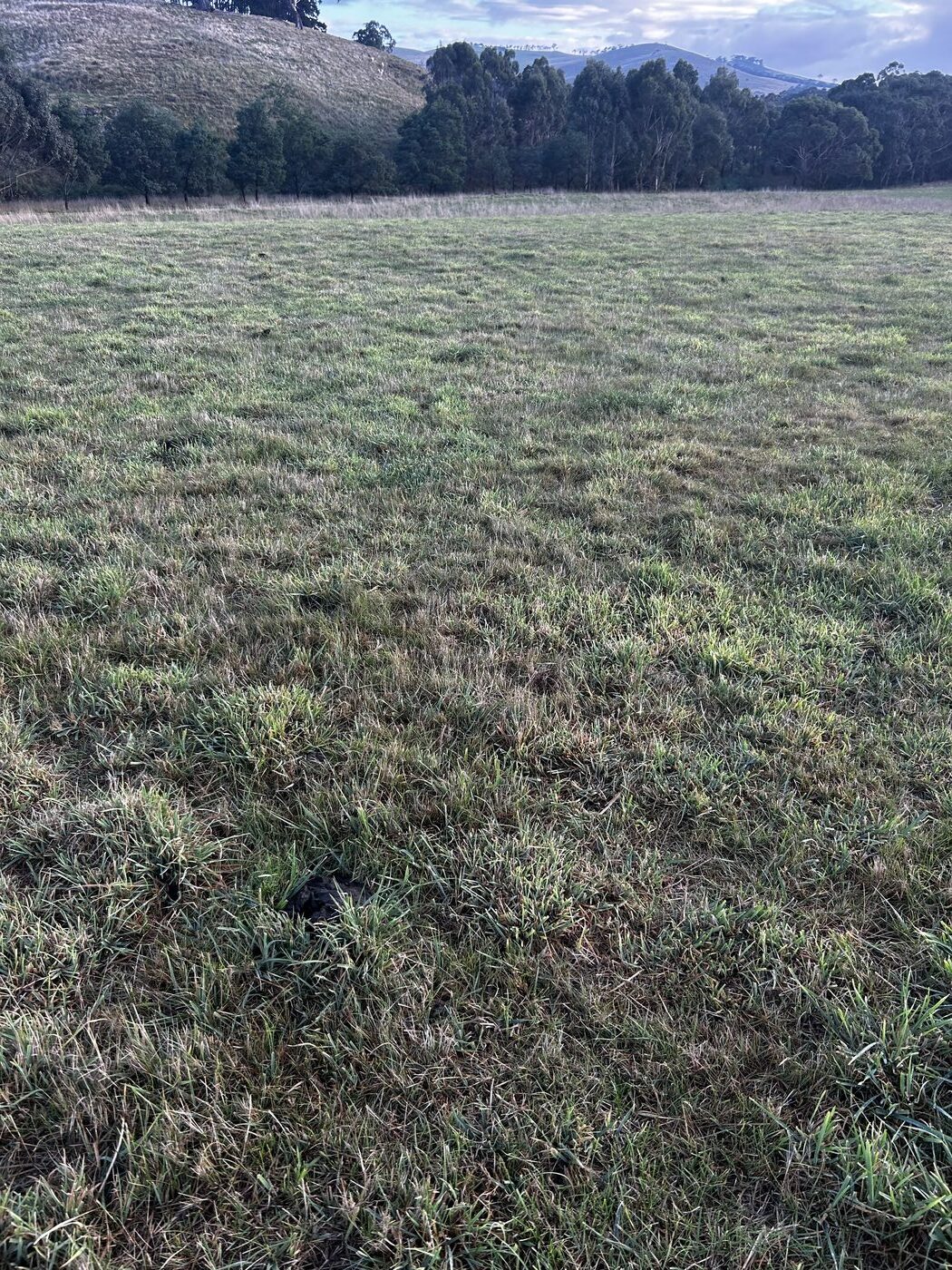
The home paddock in early winter 2026. The variation in cover across the surface reflects the mosaic of different starting points the paddock carries — creek flat, slope, and the legacy of the old pine zone.
The most visible shift is in the composition of the sward. Phalaris is still present and still clumping — its architecture has not changed — but it is no longer dominant in the way it was. What has changed is what grows between the clumps. Those inter-clump spaces are now taken up. Ryegrass, cocksfoot and clover have moved in and the ground layer is genuinely continuous in a way it was not before. That is a more significant change than it might sound: it is exactly the surface coverage that protects the soil from raindrop impact, reduces capping and improves infiltration.
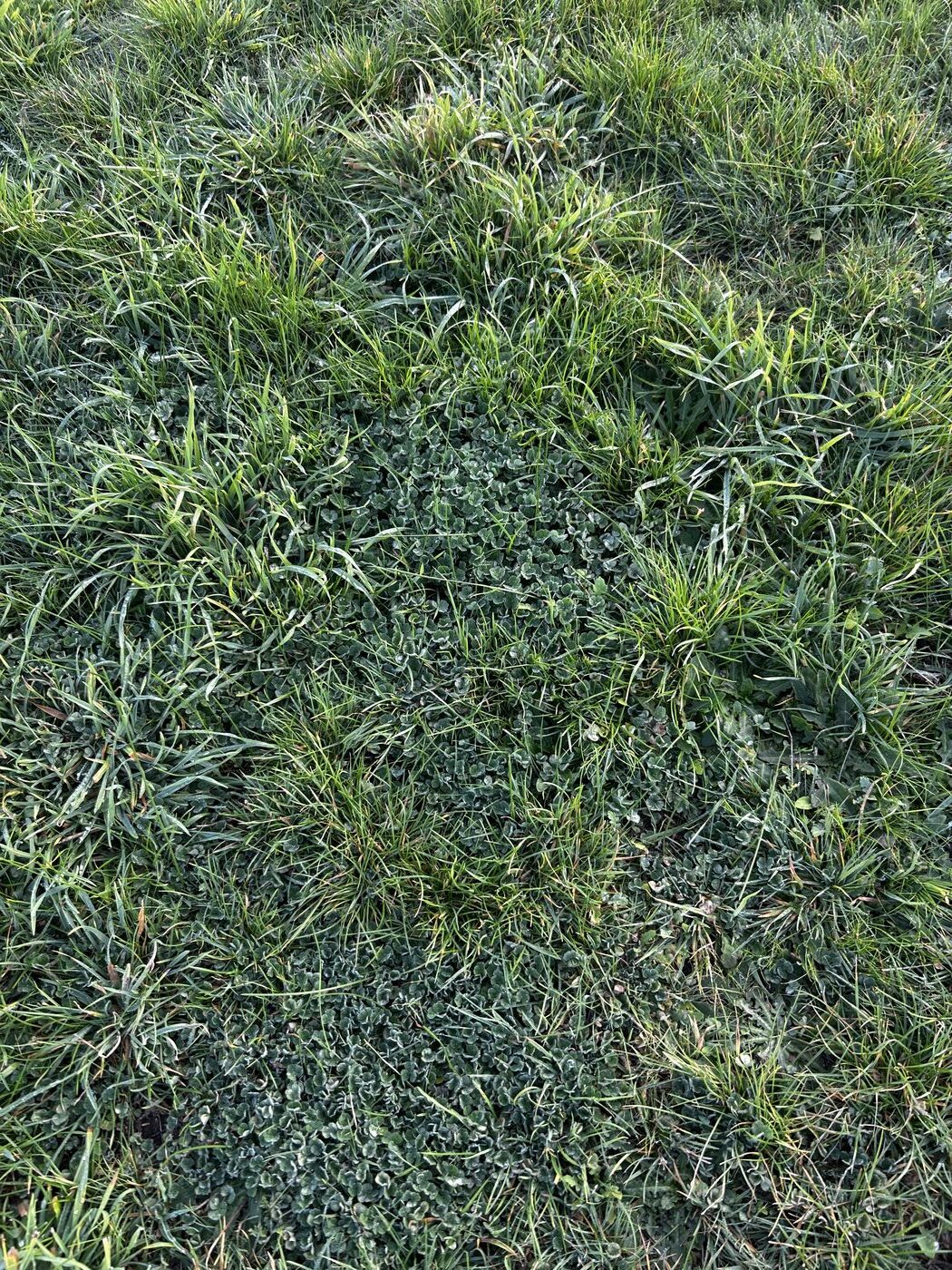
The clover increase is the most encouraging single indicator. Clover is a legume, fixing atmospheric nitrogen through root nodules in partnership with soil bacteria. Its establishment and spread tells us the soil biology is recovering enough to support that relationship — and that the paddock is beginning, in a modest but real way, to generate its own fertility. This is what Nicole Masters means by the system starting to feed itself.
The recovering sward: ryegrass and clover now filling the inter-tussock spaces that were previously bare under phalaris dominance.
The picture is not uniformly positive. Chilean needle grass persists in parts of the paddock, and this is not surprising even if it is frustrating. Transitional pastures — where a dominant species is losing its grip but the replacement ecology is not yet dense enough to exclude invaders — are actually more vulnerable to CNG ingress than either a tight monoculture or a well-established diverse sward. We are in that awkward middle phase. As the inter-clump spaces fill more completely with desirable species, the available ground for CNG establishment should reduce. But we are realistic about the timeline. Bent grass has also established in parts of the paddock — a reliable indicator of compaction, poor drainage and low fertility. Capeweed persists on the thinner soils of the slope where ground cover is still not dense enough to shade it out. All are symptoms rather than causes, and should retreat as soil structure and cover improve.
Three Decisions, One Direction
Stopping the hay cut was the first and most fundamental change. Without the annual removal of biomass, the nutrients that previously left the property in every bale now stay in the system. Grazed material is returned to the soil as dung and urine within the paddock. Ungrazed material dies back slowly and is incorporated by soil organisms. The organic matter cycle, interrupted every year by the baler, begins to close. Without the repeated machinery passes, the surface soil has had six years to begin recovering its structure — earthworms have returned in numbers to the wetter areas, opening vertical channels through the compacted profile.
Rotational grazing has done something different but equally important. Under the old set-stocking model, any plant species attempting to establish or set seed was grazed out before it had the chance. Under planned rotational grazing, stock move through the paddock in a concentrated group, graze hard and briefly, and then the paddock rests — long enough for plants to recover fully before the next grazing event. That rest period is what allows species diversity to develop, and it is what distinguishes regenerative grazing from simply reducing stocking rates: it is not about grazing less, it is about grazing differently.
A more personal addition to the system (the daily eggs!) has been the chickens — moved through the paddock in a small caravan, following behind the cattle and sheep. They scratch through the dung, breaking the pest and parasite cycle, and deposit a concentrated hit of nitrogen as they go. The fox pressure we have experienced means we keep the caravan close to the house rather than ranging it freely across the whole paddock, which limits their reach; but within that constraint they are doing useful work. Each time we move the caravan we apply a layer of mulch or straw over the area they have just worked, diluting the nitrogen load and beginning the carbon-to-soil process. It is a small intervention, but it is the right direction: biology doing what biology does, with a little management to keep it in balance.
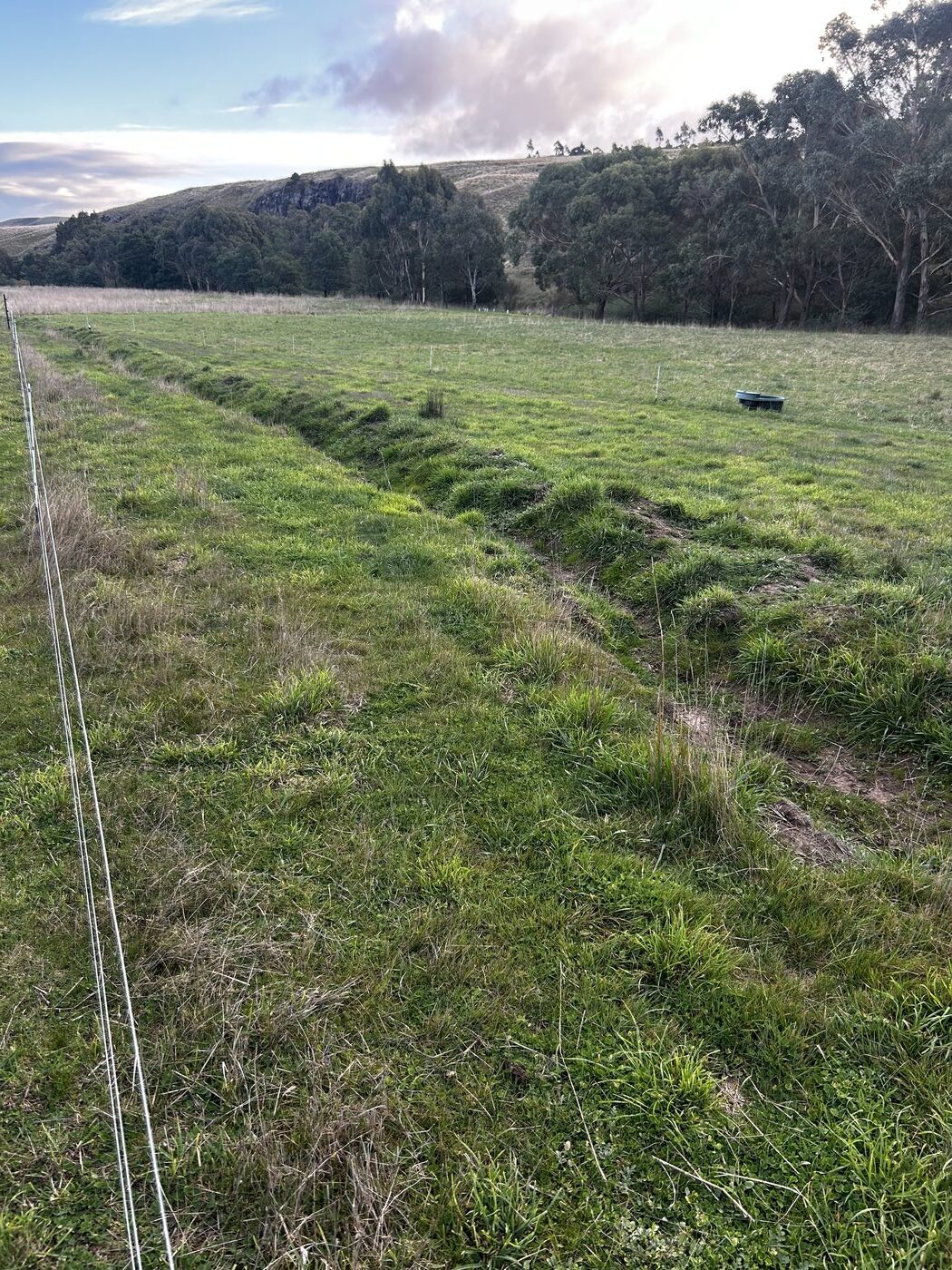
The contour swales installed in early winter 2025 have added a third dimension. They are placed where water once naturally flowed across the landscape — we are restoring that function. Plants are also necessary to support the contours in this work, restoring the natural flows of water and the hydrology of the system. One swale runs through the slope above the creek flat, intercepting rainfall moving down from higher ground and holding it long enough to infiltrate rather than run off. A second runs along the creek flat itself, slowing surface water before it reaches the creek. The fenced planting corridor now going in sits below the upper contour, fed by the moisture it is collecting — and in turn stabilising the earthwork and deepening its effect on the water cycle. Within a single season the effect is already visible: the pasture below the upper swale is noticeably more sustained than it was. Water that was previously leaving the property is now staying in it, doing work.
The contour swale installed in winter 2025, running across the slope above the home paddock. The band of more vigorous green growth immediately below the berm is already visible — water held in the landscape rather than shed from it.
The June Planting
We have been planting since 2021 — Acacias, Sheoaks and Eucalypts along internal fence lines and in paddock corridors, trees that are now established and visible across the property. Any tree a visitor sees inside a paddock at Mirrim Wurnit was put there by us. This June’s planting is a continuation of that work, not its beginning, but it is the most deliberate and ecologically considered planting we have done: a fenced corridor running through the middle of the home paddock, below the upper contour swale, planted with local native species drawn entirely from what belongs here on the Victorian Grassy Plains basalt country — Carex, Poa labillardiei, Acacias, Cassinia and Eucalypts. It will provide stock shelter the paddock currently lacks, a biodiversity spine connecting habitat across the property, and deep root architecture that introduced pasture grasses simply cannot provide.
The June plantings below the contour, now full of water. Late winter 2026.
The Acacias will establish fastest and do the most immediate biological work, fixing nitrogen from the atmosphere and creating the sheltered microclimate under which slower species can take hold. Over time the Eucalypts will come to dominate the canopy. The Poa and Carex will fill the ground layer. The corridor will become a recognisable piece of Victorian Grassy Plains woodland threading through the middle of what is otherwise still a conventional-looking paddock.
There is also something more personal in the choice of species. Early survey maps of this property, drawn when the lots of this district were first being marked out in the nineteenth century, carry notes referring to the preponderance of Lightwood and Blackwood across this country. Both are Acacias. The same maps refer to what the surveyors called Cherry Gum, most likely Red Box, Eucalyptus polyanthemos, which we have been planting across the slopes, along with Manna Gum, Eucalyptus viminalis, on the creek flat where it belongs. They were here before the clearing. Planting them back is not an introduction. It is a return.
It will not look like much for the first few years. The plants will be small, the fencing conspicuous, the bare ground between establishing plants an invitation to weeds. We will manage it carefully through that establishment phase, controlling competition and protecting the corridor from stock. And then, gradually, it will begin to look like something. We expect to be watching that process for the rest of our time on this property.
What We Are Watching For
Native grass species returning spontaneously would be the most significant longer-term marker. Under the old regime they were eaten or cut out before they could establish. Planned grazing, with its long rest periods, gives them the window they need. We have good reason to think this realistic rather than merely hopeful: the road reserve along our boundary carries kangaroo grass and spear grasses, both characteristic species of the Victorian Grassy Plains basalt country that once covered this landscape. Road reserves are often the last refuge of remnant native grassland species, never having been ploughed or intensively improved. Their survival there tells us the ecological memory of this country is still present within metres of the paddock fence.
Earthworm activity spreading into the drier parts of the paddock, away from the creek margin where they have always been present, would indicate that soil structure and moisture in those areas is improving enough for them to colonise further — one of the most reliable and visible signs of recovering soil health.
Dung beetles are another indicator we are watching, and here there is already something to report. They have begun arriving from neighbouring properties — the species that work cattle dung are the first to appear, which is consistent with what is recorded elsewhere: the cattle-dung feeders tend to colonise new ground ahead of those associated with sheep. Whether the sheep-dung species are yet established we cannot say with certainty, but in any case the beetles will do their work regardless: tunnelling dung into the soil profile, improving infiltration, cycling nutrients directly where the roots can reach them. Their presence is a sign that the paddock is becoming a place worth arriving at.
Water behaviour after rain is the other thing we watch closely. The difference between a paddock that sheets water after twenty millimetres and one that absorbs it is visible within minutes of a decent shower, and it tells you more about the state of the soil than most laboratory tests would.
The home paddock is the most personal piece of this whole project. It is what we look at over the fence every morning. It is where the June planting will be most visible and where its progress, or lack of it, will be most closely felt. We have no illusions about the timeline. But six years in, with the swales doing their work and the planting going in, the paddock is unambiguously moving in the right direction.
We will report back as the seasons turn.
Peter The Farm at Mirrim Wurnit · Monegeetta, Victoria
5 May 2026Land & water
Water security starts in the landscape
Water security in regional areas is often framed in terms of supply.
On the ground however, I think as much about how water moves across
and through the landscape.
Grazing practices play a direct role in that. Soil structure,
ground cover and contour all influence whether rainfall is
retained, slowed and used productively, or lost quickly through
runoff.
On our property in the Macedon Ranges, we have been applying
Natural Sequence Farming principles as part of a broader approach
to land management. Contours are installed where water once
naturally flowed across the landscape, restoring that function
and keeping water on the property for longer, allowing it to
infiltrate and support pasture, while also improving the quality
of water that eventually leaves the system and flows into Deep
Creek. Plants are also necessary to support the contours in
restoring natural flows of water across the landscape, and the
hydrology of the system. We are
using these contours as the basis for a targeted planting
program; establishing shelter, stabilising soils, deepening
the root architecture that anchors the earthworks and sustains
their hydrological function, and enhancing
biodiversity across the landscape. By rehydrating the landscape
and maintaining higher soil moisture and ground cover, these
approaches also contribute to fire resilience; reducing fuel
loads, slowing fire spread, and supporting quicker post‑fire
recovery.
It is a practical approach, requiring a shift in how land and
water are considered together, rather than separately. Fencing
and grazing practices also need to be adapted to fit the
landscape and the contouring, ensuring stock movement and pasture
utilisation work with, rather than against, the hydrology of the
system. In a changing climate context, where variability is
increasing and there remains the possibility of a strong or even
super El Niño event this year, this kind of
landscape‑scale adaptation becomes increasingly important
for maintaining ground cover, water retention, and broader
resilience.
There is good work happening in this space. Jason McAinch and the
Healthy Landscapes program, a joint initiative of local councils,
catchment management authorities, water corporations and Landcare
groups, has been a strong advocate for approaches that improve
both farm productivity and broader catchment outcomes.
I would strongly encourage landholders to engage with programs
like this, particularly those who are newly establishing
themselves on the land. The benefits are practical, and the
cumulative impact across a catchment is significant.
These are not abstract or unproven ideas. They go to the
resilience of regional landscapes and the long‑term
security of the water systems they sit within; requiring genuine
collaboration between landholders, catchment managers, and local
government to deliver lasting outcomes.
24 April 2026Energy & resilience
Energy security, close to home
Energy security is often treated as a national policy issue. In
regional Australia, it is much closer to daily life — felt in
diesel bills, petrol prices, and exposure to global shocks well
beyond local control.
Our farm sits nearly 10 kilometres from the nearest town and
more than an hour from Melbourne. The property is off‑grid
for both electricity and water. That brings a level of
independence, but it also makes energy decisions very real.
Diesel still runs a backup generator, and gas still does the
heating — both we would prefer to replace over time.
Heavy farm machinery will remain dependent on diesel for some
time. That is simply the reality on the ground. But it should
not distract from where change is already practical.
A large share of fuel use in regional areas sits in light
vehicles. Utes and everyday transport now have credible electric
alternatives. With solar and batteries becoming more common on
farms, those vehicles can increasingly be charged on site. That
starts to shift part of the energy task from imported fuel to
locally generated power.
At a broader level, that strengthens resilience and reduces
exposure to price volatility. For households and farmers, it
brings a greater degree of control over an essential part of
daily life.
Not everyone has the ability to generate and store their own
energy. In those cases, EV charging in regional towns plays an
important role. It supports local use and, as noted previously,
brings additional visitors into those communities.
Energy security improves by acting where change is already
achievable, rather than waiting for complete transformation.